
"LET HIM THROUGH." — THE NIGHT JELLY ROLL STOPPED A SHOW AND TURNED AN ARENA INTO A SECOND CHANCE
It happened in a flash — the kind of moment security teams are trained for.
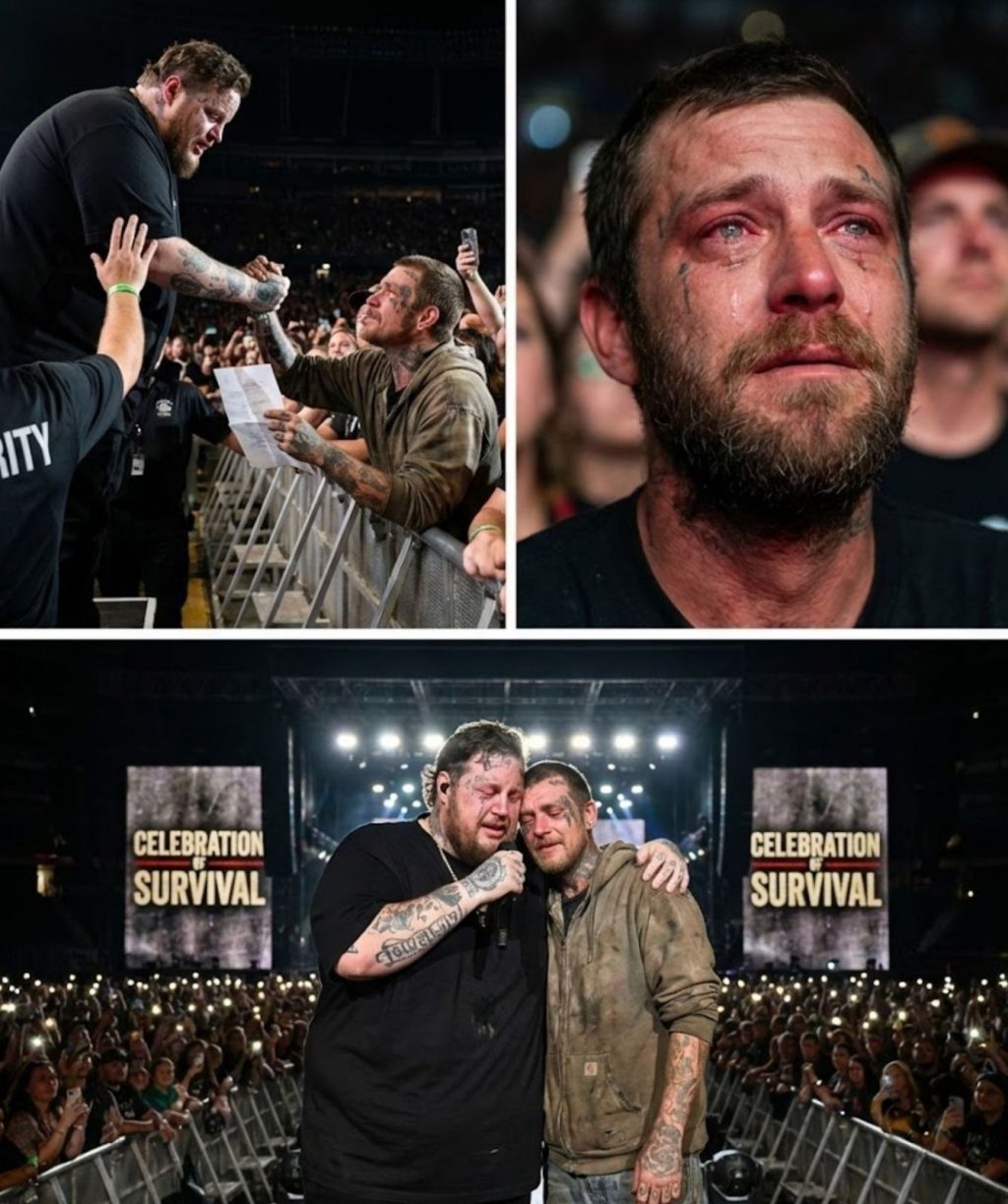
A man, inked from head to toe and worn by years most in the room could only imagine, stepped forward from the crowd and tried to toss a folded piece of paper onto the stage. Instantly, security guards moved in. Their posture shifted. Their hands tightened. In a packed arena, caution is not optional — it is necessary.
But Jelly Roll saw something different.
He did not see a threat.
He saw trembling.
With a small but unmistakable gesture, Jelly Roll motioned for the guards to step back. The command wasn't loud. It didn't need to be.
"Let him through."
The folded paper landed near his boots. The music softened. The arena, moments earlier roaring with energy, began to quiet. Jelly Roll bent down, picked up the note, and unfolded it slowly — not rushing, not playing to the cameras, but treating the paper like it carried weight.
Because it did.
He lifted the microphone and read the words exactly as they were written:
"I listened to your music in my cell for 10 years. Today is my first day of freedom."
The sound that followed wasn't applause.
It was a collective intake of breath.
You could feel it ripple through the building — tens of thousands of people suddenly aware that this was no longer just a concert. It was something fragile. Something real.
Jelly Roll did not grin. He did not turn the moment into a punchline or spectacle. His expression shifted — softened — as if he understood the distance between a prison cell and an arena seat. He knows something about hard roads. He has spoken openly about his own past struggles, about mistakes, about consequences, about redemption earned slowly and painfully.
He stepped to the edge of the stage and reached out his hand.
The man hesitated only a second before taking it.
Pulled up onto the platform, he stood blinking in the glare of lights he likely never imagined standing beneath. His hands shook. His shoulders carried years that do not disappear simply because a door has opened.
Jelly Roll placed his own microphone into the stranger's grip.
"This isn't my show anymore," he said quietly. "This is a celebration of survival."
There was no background speech. No prepared message. Just two men standing shoulder to shoulder — different stories, different paths, but marked by some of the same scars life leaves behind.
The band, sensing the gravity of the moment, eased into a slow, steady melody. Nothing overpowering. Just enough sound to hold the space.
Tears fell freely — not dramatic, not hidden. Jelly Roll did not look away from the man beside him. He stood close, steady, as if silently saying, You're not alone up here.
When the former inmate leaned toward the microphone, the arena leaned with him.
What he said next was not polished. It was not rehearsed.
It was truth.
He spoke about nights in a small cell, about replaying songs through cheap headphones, about hearing lyrics that reminded him he was still human — still worthy of hope. He spoke about counting days. About regret. About wanting one chance to stand somewhere honest and say thank you.
His voice cracked. No one laughed. No one shouted.
People cried.
Because what filled that arena was not celebrity. It was recognition — the understanding that freedom, in any form, is never small. That music, when it reaches someone at their lowest point, becomes more than entertainment. It becomes oxygen.
Jelly Roll did not interrupt. He did not add commentary. He let the man finish.
And for a long, suspended moment after the last word left the microphone, no one in that building could find their voice.
Then came the sound — not wild cheering, but something deeper. Applause that built slowly, like people returning from somewhere sacred.
It wasn't about fame.
It wasn't about headlines.
It was about second chances.
In an industry often fueled by spectacle, Jelly Roll chose empathy. In a moment where fear could have dictated the outcome, he chose discernment. He recognized trembling instead of threat. Pain instead of danger.
That decision transformed an arena.
Because sometimes the most powerful part of a show is not the song on the setlist — it's the reminder that every person in the crowd carries a story. Some are still writing theirs. Some are just beginning again.
That night, under bright lights and before thousands, a folded piece of paper became a testimony.
And a concert became something far greater —
a stage wide enough for redemption.