
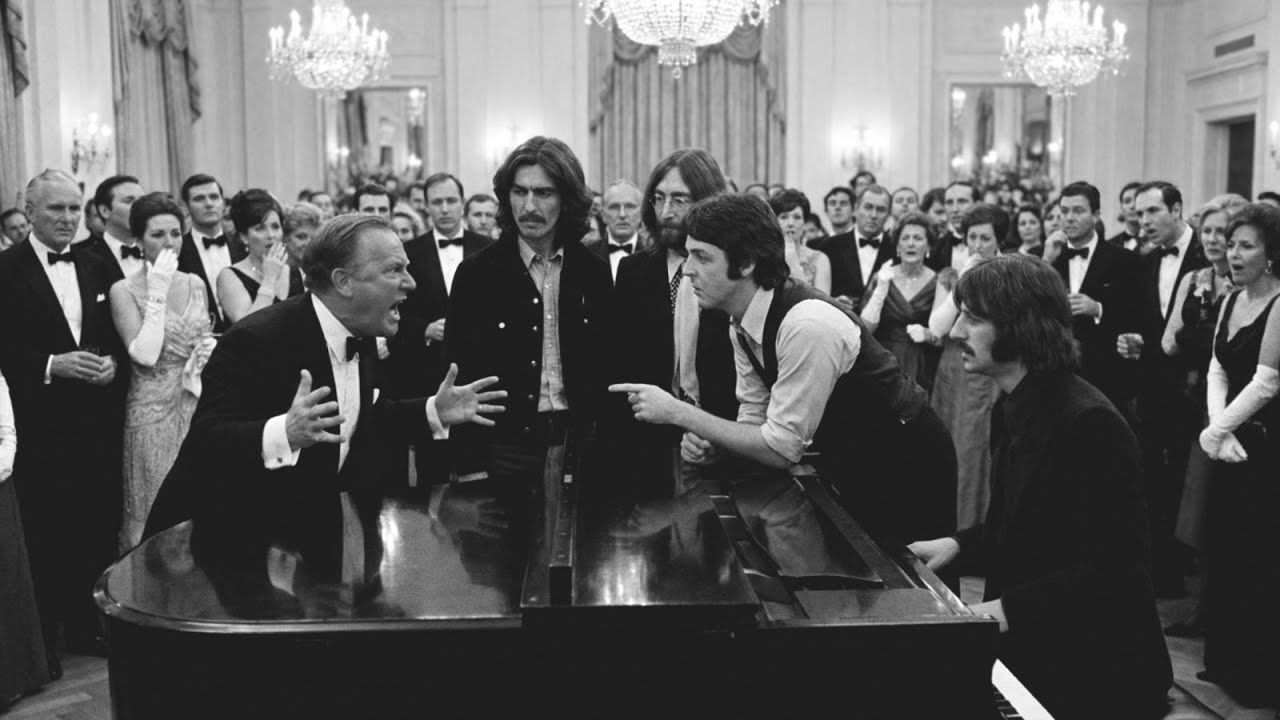
London, 1969.
Beneath the high, watchful ceiling of Royal Albert Hall, the room had already chosen its sides. Formal dress, measured applause, and a long tradition of certainty filled the air before a single note was played. When The Beatles took their place, they did not walk into hostility, but into something more complex—doubt shaped by expectation.
The question arrived without hesitation. Could they play real music? It was not framed as curiosity. It was delivered as a challenge, clear enough for every corner of the hall to hear. For a brief moment, even John Lennon, Paul McCartney, George Harrison, and Ringo Starr stood still. Not defeated, but aware. Pride met uncertainty, and neither spoke first.
💬 "Real music is music that touches hearts."
The voice came from the back—young, unguarded, and steady enough to carry. It did not argue. It clarified. In that instant, the room shifted, not loudly, but perceptibly, as if something essential had been named and could no longer be ignored.
What followed did not resemble a contest. There was no attempt to prove, only to express. Harrison's guitar searched rather than declared. Lennon's melody arrived fragile, almost conversational. Starr's rhythm held everything together without demanding attention. At the piano, McCartney chose restraint over display, allowing space to speak where technique might have dominated.
They did not imitate tradition. They met it. And then, without force, they moved beyond it.
The hall responded in its own language—silence first, then recognition. Not the kind that erupts, but the kind that settles. The earlier division softened. The question, once sharp, no longer required an answer. It had already been resolved.
This was not victory. No one had been defeated. The classical world remained intact, just as the band's identity remained unchanged. But something quieter, and perhaps more lasting, had taken place. Understanding replaced assumption. Respect emerged without demand.
Moments like this rarely announce themselves as important. They pass without ceremony, leaving only a subtle realignment behind. Yet they endure, precisely because they do not insist on being remembered. They simply remain true.
That night, under the steady lights of Royal Albert Hall, the meaning of "real music" was not redefined through argument or authority. It was revealed through presence. Not in volume, not in complexity, but in connection.
And when the final notes faded, what lingered was not applause alone, but a shared recognition—quiet, undeniable, and complete.