
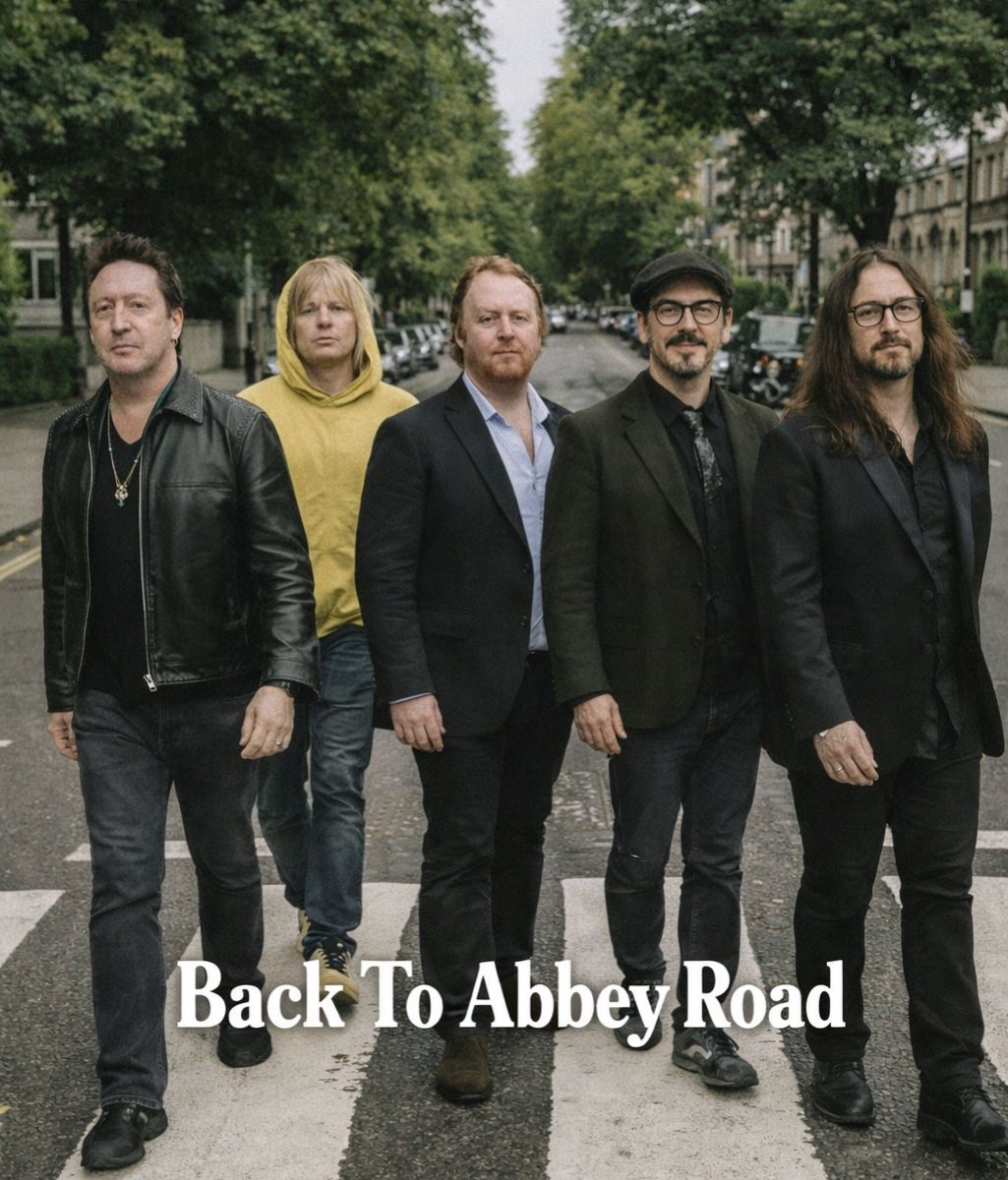
It was never advertised. No posters on London walls. No advance notice to the press.
Just a private room not far from Abbey Road Studios, where footsteps once crossed into history. Then five figures stepped quietly into the light: Julian Lennon, Sean Lennon, Dhani Harrison, Zak Starkey, and James McCartney. They did not arrive as successors. They arrived as custodians.
The piece was titled Back To Abbey Road. It opened with a progression that felt unmistakably familiar—layered harmonies that gently recalled The Beatles without imitating them. Yet as the structure unfolded, the direction shifted. Minor chords replaced expectation. Percussion held back rather than pushed forward. The lyrics spoke not of revival, but of inheritance—of carrying something fragile across time.
The room listened differently than it would at a public concert. There was no restless anticipation, no hunger for spectacle. The performance felt deliberate, almost archival in tone. Voices intertwined with care, as if aware that harmony itself was the message. Each artist stood distinct, yet aligned by shared history rather than obligation.
💬 "This was never about stepping out of their shadow — it was about walking back to where it began."
That sentence settled over the audience like a quiet understanding. No dramatic gesture followed. No attempt to claim a moment larger than it was. Instead, the music expanded inward, deepening rather than soaring. Zak's restrained rhythm allowed space to breathe. Dhani's phrasing carried reflection rather than declaration. Julian and Sean shaped their lines with emotional precision. James anchored the arrangement with subtle steadiness.
When the final chord arrived, it did not demand applause. It invited stillness. A whispered dedication lingered in the air: for our fathers. Then silence, thick and unforced, filled the room. It was not the silence of uncertainty. It was the silence of recognition.
There was no encore. No announcement of future plans. The doors did not open to flashing cameras. Those present understood that what had occurred was not a revival, but a continuation—brief, intimate, and complete in itself.
For a moment, history did not feel distant. It felt present, not as repetition, but as renewal. The crossing outside remained unchanged. The studio walls stood as they always had. Yet inside that quiet space, something subtle shifted. Legacy proved it could be both inherited and reborn—without spectacle, without noise, and without losing the humility that made it matter in the first place.